New · Multi-hypothesis investigations with confidence states are now live. Learn more →
How it works The model Evaluation Case study Get started for free Launch the app Login

Find the cause. Verify the evidence. Fix the system.

RootVector is an autonomous incident-investigation agent that traces production failures across logs, metrics, deployments, source code and team chatter — then returns a root cause with evidence, a confidence score, and a human-approved fix.

Logs
Metrics
Code
Deploys
Tickets
Vector

Checkout Service Investigation

ResolvedHigh Severity
Incident #INC-2841 · Detected 10:41 AM · Resolved 11:07 AM · 26 min
Detect10:41
Collect10:42
Analyze10:46
Root Cause10:52
Remediate11:02
Resolved11:07
Root Cause IdentifiedConfidence 92%
Connection pool exhaustion in database due to unclosed connections in payment-service v2.8.1 under high traffic.
Evidence
Logs
234 matches
Metrics
Latency spike
Traces
Pool timeout
Code
Connection leak
Deploys
v2.8.1 · 10:32
Impact
  • Affected Users: ~1,247
  • Error Rate: 23.6%0%
  • Duration: 21 minutes
What We Did
  • Scaled database connections
  • Restarted payment-service pods
  • Deployed hotfix for leak
View Remediation Logs →
RootVector agent
9:41RootVector
Wednesday, 5 August
9:41
CRITICALINC-2841now
payment-service returning 5xx errors
SEV1INC-2841live
payment-service · 5xx
Incident detected
Checking deployments…
Found v2.8.1 (11m early)
Searching GitHub…
PR #4821 · retry logic
Confidence0%
+Deploy 11m before
+Retry guard removed
DB latency — ruled out
Rolled back — recovery verified
RootVector is monitoring…
See it in action

Watch RootVector work a real incident, end to end

Six guided steps — from the moment an error is detected to a human-approved fix and verified recovery. No setup, no sign-up. Just press play.

app.rootvector.ai/demo
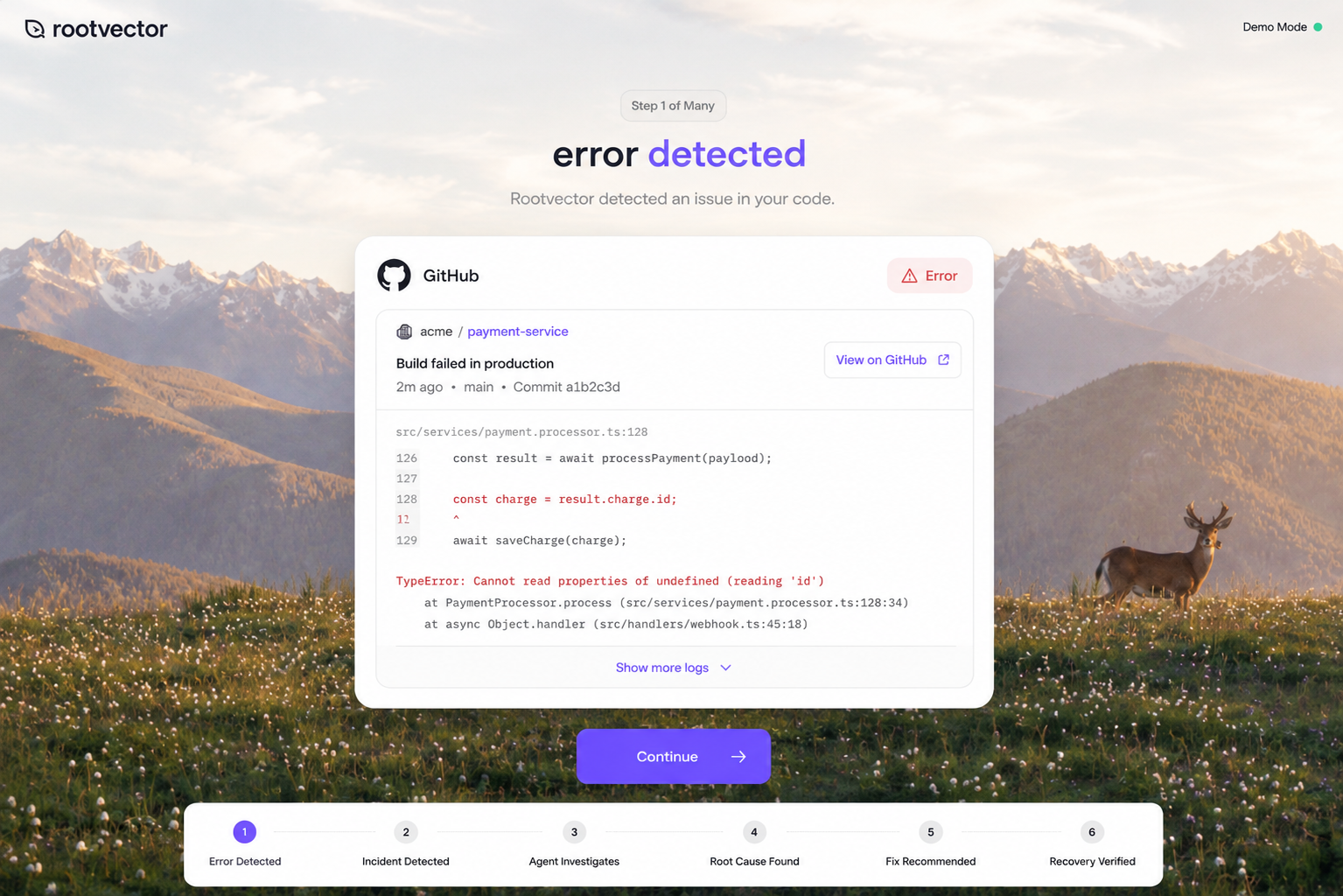
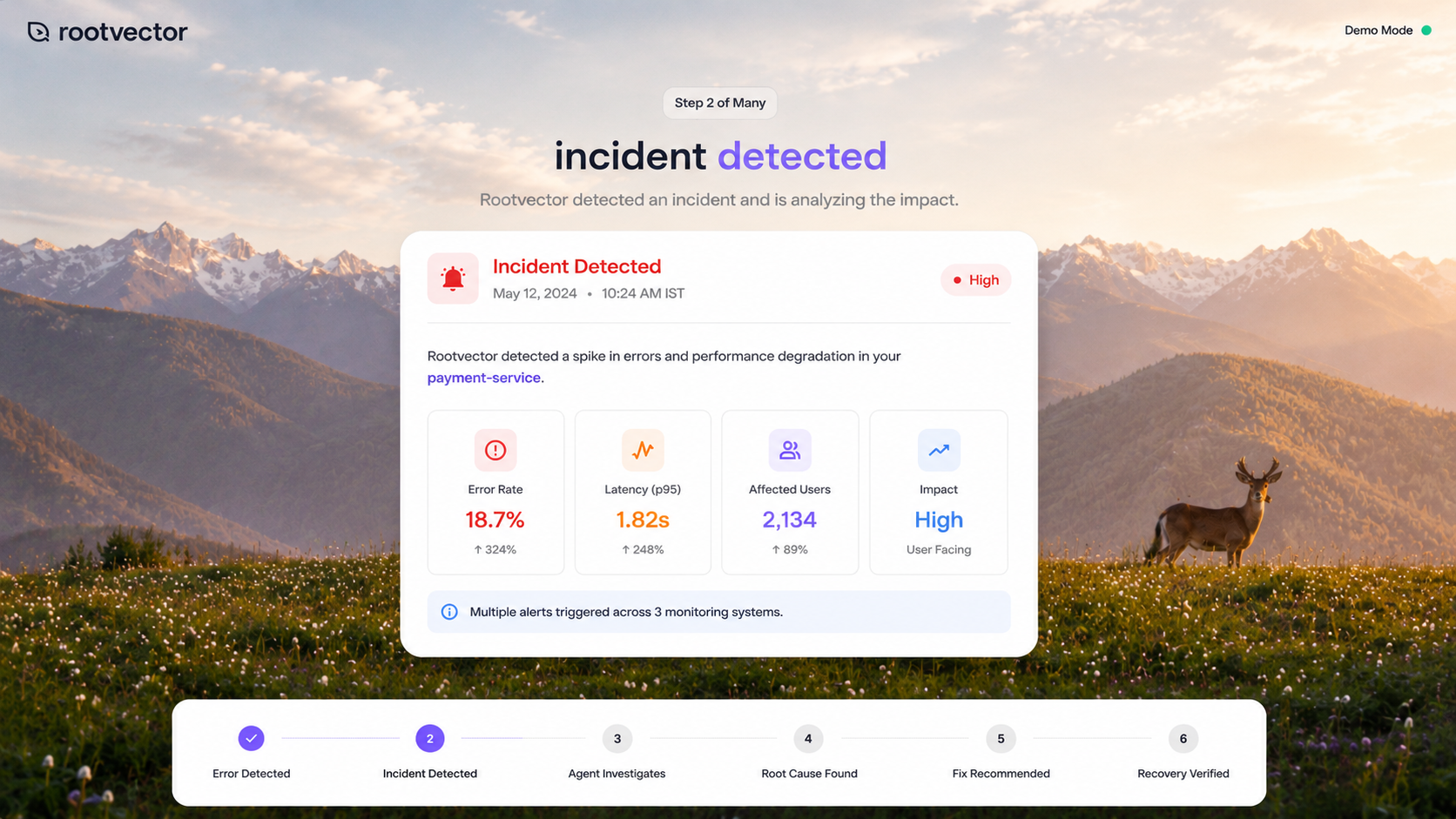
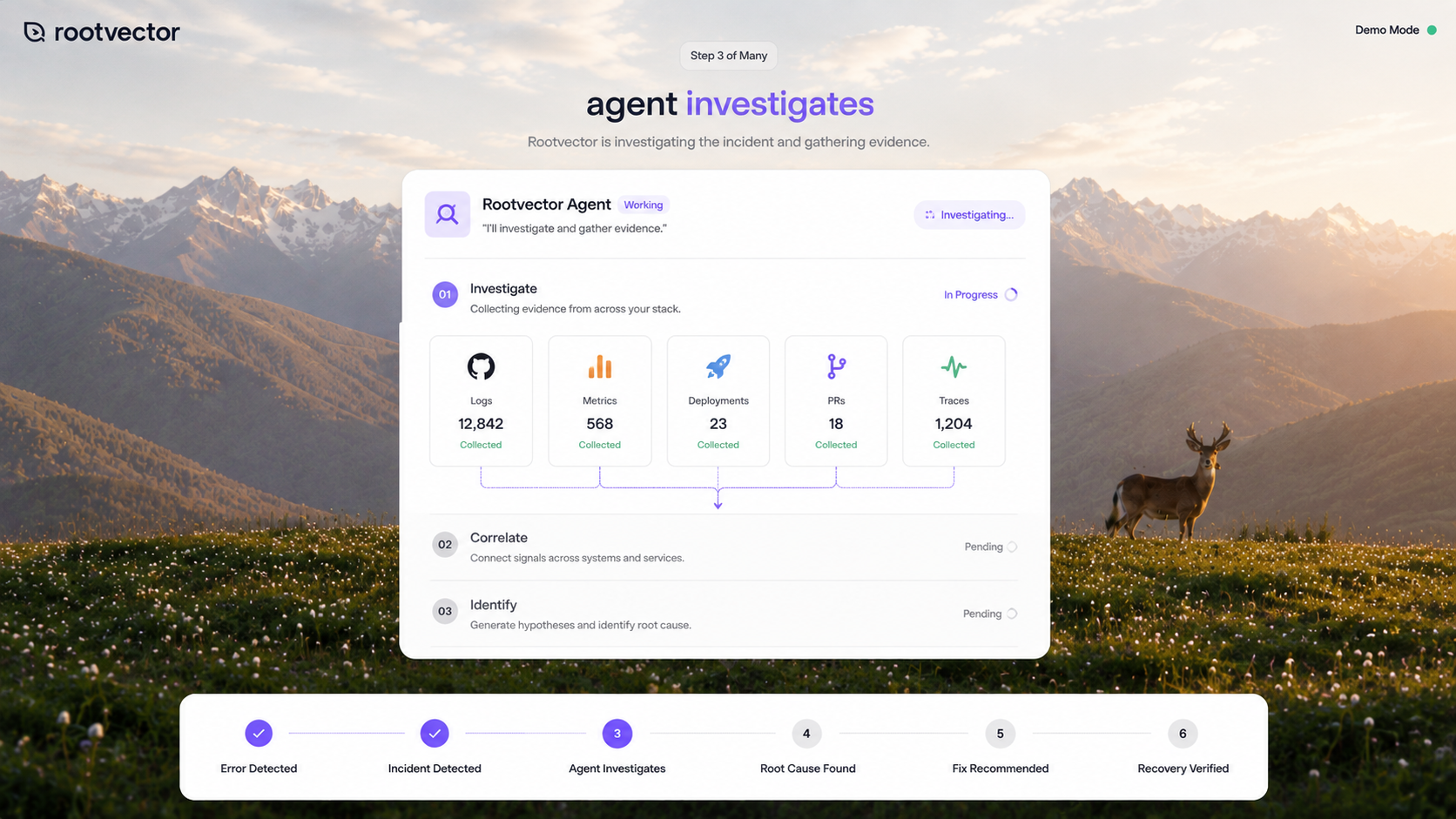
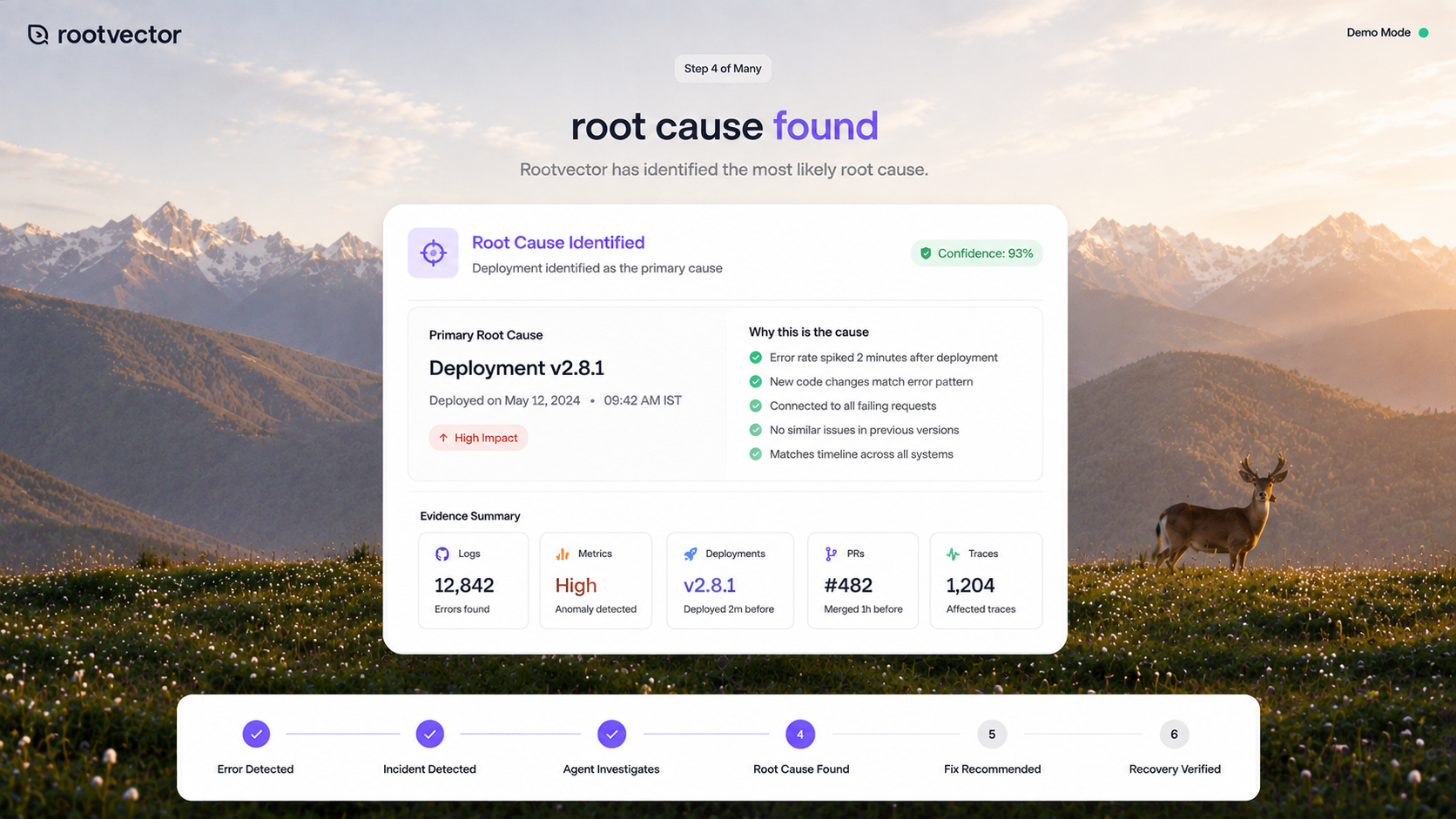
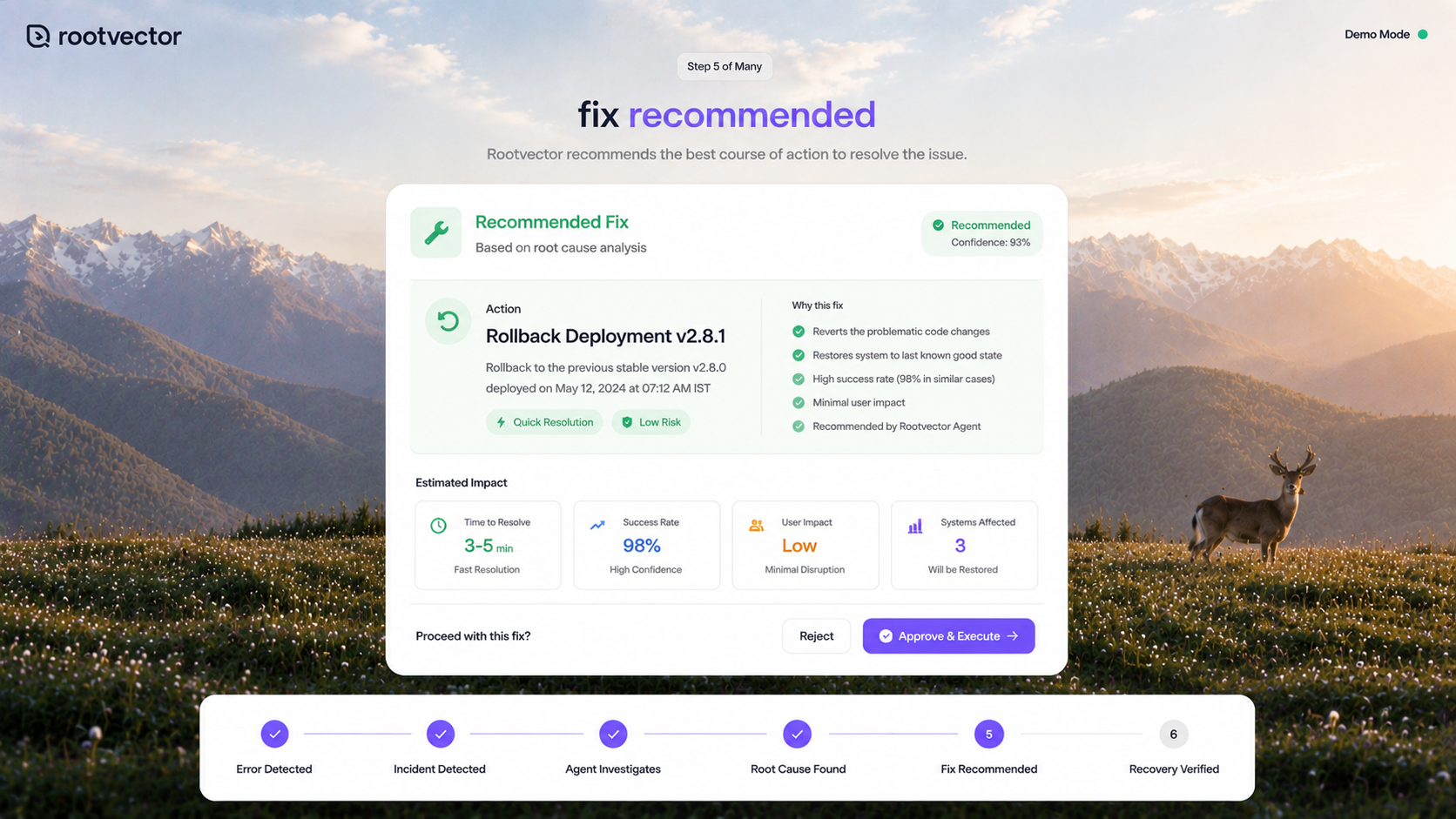
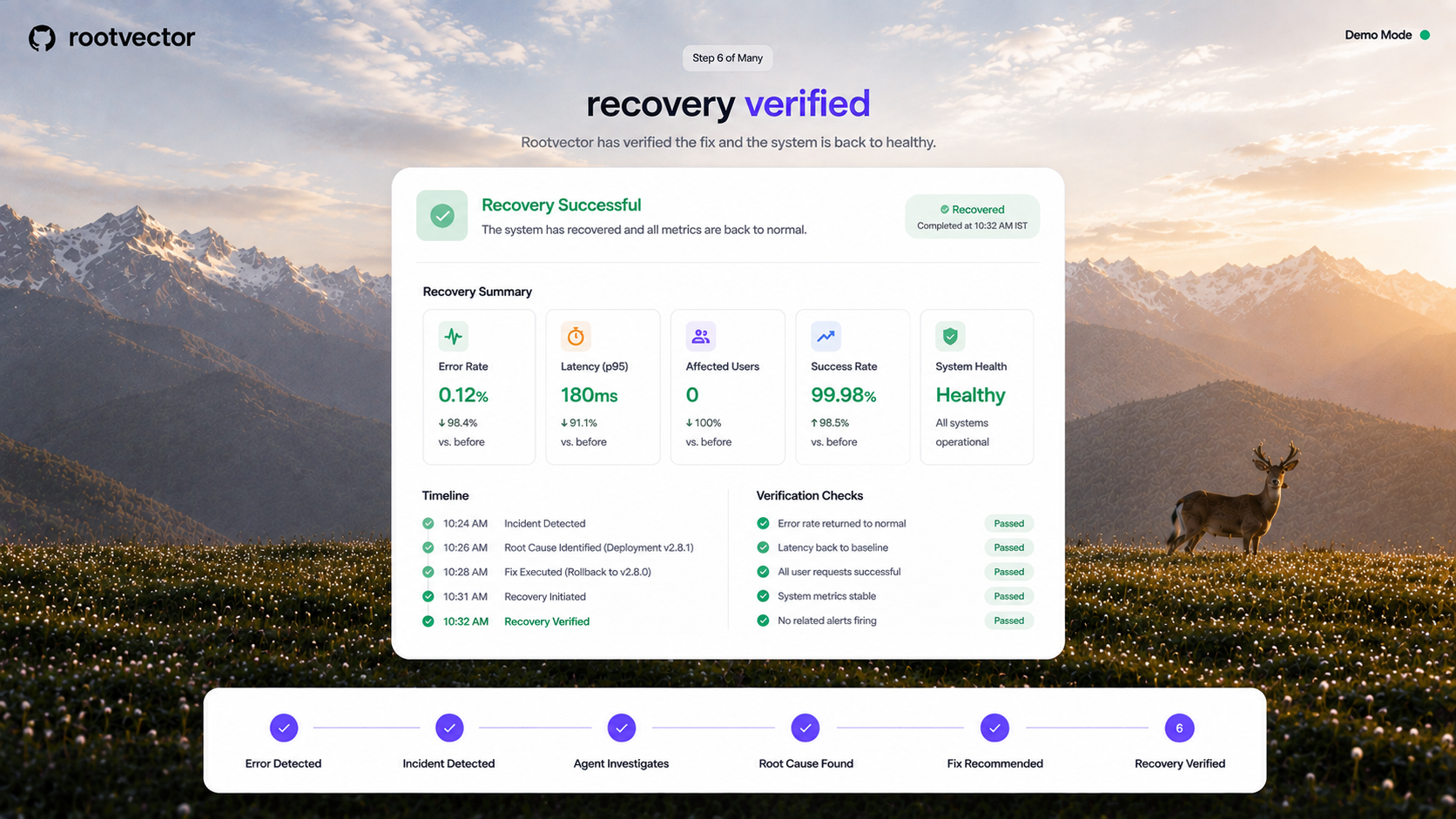
RootVector walkthrough, step 1: an error is detected in the payment-service GitHub build, showing the failing code line and the TypeError stack trace. Step 2: incident detected — error rate 18.7%, latency 1.82s, 2,134 affected users, high user-facing impact. Step 3: the agent investigates, collecting logs, metrics, deployments, PRs and traces across the stack. Step 4: root cause found — Deployment v2.8.1 identified as the primary cause with 93% confidence. Step 5: fix recommended — roll back Deployment v2.8.1 to v2.8.0, awaiting human approval. Step 6: recovery verified — error rate 0.12%, latency 180ms, all systems healthy.

Trusted by teams where downtime isn't an option

◆ Northwind
Vantage
⬡ Helio
Ledgerly
◎ Cobalt
Skyforge
△ Meridian
Orbital
✳ Beacon
Quanta
◈ Lumen
Fathom
The problem

Incidents are slowing you down

The real cost of an incident isn't just downtime. It's the engineers who dropped everything, the customers who were impacted, and the roadmap that keeps slipping — while one person stitches logs, deploys, GitHub, Slack and past incidents together by hand for 30–60 minutes.

LIVEStitching it together by hand · 34:12
System is downINC-2841 · SEV1
Monitoringerror rate spiking
Logsduplicate_transaction
GitHubPR #4821
Slack“duplicate charges?”
How it works

Hand it a problem. Get back a case file.

RootVector isn't “chat with your logs.” You hand it an incident and it runs the whole investigation itself — then stops for your approval before doing anything risky.

1

An incident appears

Error rate up, latency up, orders down — real or simulated. You click Investigate.

2

The agent works, visibly

It builds a plan and calls real tools — logs, deploys, GitHub, Slack, past incidents — step by step.

3

Hypotheses, weighed

It forms competing hypotheses and gathers evidence for and against each, ruling them in or out.

4

A traceable root cause

Deployment → code change → error pattern → discussion → precedent, each with a confidence score.

5

You approve the fix

It proposes a remediation — like a rollback — but never executes without an explicit human OK.

6

It verifies recovery

After the fix, it re-checks the metrics to confirm the incident actually resolved.

The flow

From alert to
verified fix.

RootVector investigates production incidents autonomously, connects the dots, and gets you back to green — faster.

01
InvestigateAn incident lands, and the agent gets to work immediately.
02
CorrelateAgent connects signals across your stack and gathers evidence.
03
IdentifyRoot cause surfaced with confidence and clear impact.
04
ResolveRecommend fix, verify recovery, and prevent recurrence.
decision timeline
Incident detected10:42:03 · payment-service
10:42:03
Plan built — deploy, code, logs10:42:04
10:42:04
v2.8.1 shipped 11 min beforeget_recent_deployments()
10:42:08
PR #4821 removed idempotency guardsearch_github()
10:42:12
Error spike correlated with deploymentsearch_logs()
10:42:16
Hypothesis: deployment causal10:42:22
10:42:22
Current hypothesis
Deployment v2.8.1 is causing an error spike in payment-service.
91%Confidence
Evidence found (14)
Deploymentsv2.8.1 deployed 11 min before incident
2 signals ›
GitHubPR #4821 modified retry logic
3 signals ›
Logsduplicate_transaction errors detected
5 signals ›
Metrics5xx spike starts after deployment
2 signals ›
Incident HistorySimilar incident: INC-1933
2 signals ›
View full evidence graph →
Investigating…
INC-2841 Correlating 10:42 AM Live

Correlating across your stack

RootVector is connecting related signals and building a causal graph.

8
Data sources connected
142
Signals correlated
36
Entities identified
91%
Correlation confidence
Strong
Causal graph (live)+ Auto-discovered⌕  100%  ⤢
Deploymentsv2.8.1 · 10:31
GitHubPR #4821 · 10:15
Logsproduction · 10:24
Metricserror_rate · 10:24
Idempotency removedCode change
Duplicate transactions+1,284 · Impact
Error rate spike18.4% · Observed
Payment failures5xx · impact
Strong linkWeak linkNo link
Top correlated signals
Error rate spikeprometheus · payment-service
Strong
Idempotency guard removedgithub · PR #4821
Strong
Deployment v2.8.1argo · production
Strong
DB latency increasedatadog · primary-db
Medium
Payment failures (5xx)kafka · payment-events
Strong
View all correlated signals →
Evidence timelineSignals aligned within 12 min before the spike.
10:31 AM
Deployment v2.8.1Shipped to production
10:33 AM
Idempotency removedPR #4821 merged
10:42 AM
Error rate spike18.4% increase
10:43 AM
Payment failures5xx detected
Correlating continuously…New signals ingested and relationships updated in real time.
evidence graph
Deploy v2.8.110:31 payment-serviceaffected duplicate_transaction1,284 errors
Why this evidence matters
PR #4821 — retry logic
Removed the idempotency-key guard, directly producing the “duplicate_transaction” errors in the logs.
remediation · human-in-the-loop
Roll back deployment v2.8.1
Restores the idempotency guard. Blast radius: payment-service pods only.
✓ Approve & executeReject
error rate · after rollback0.4%
Recovery verified · back to baseline
The platform

Meet the platform keeping your systems running

From your logs, metrics, deployments and code — through autonomous investigation, competing hypotheses and evidence — to a human-approved fix and verified recovery, all in one view.

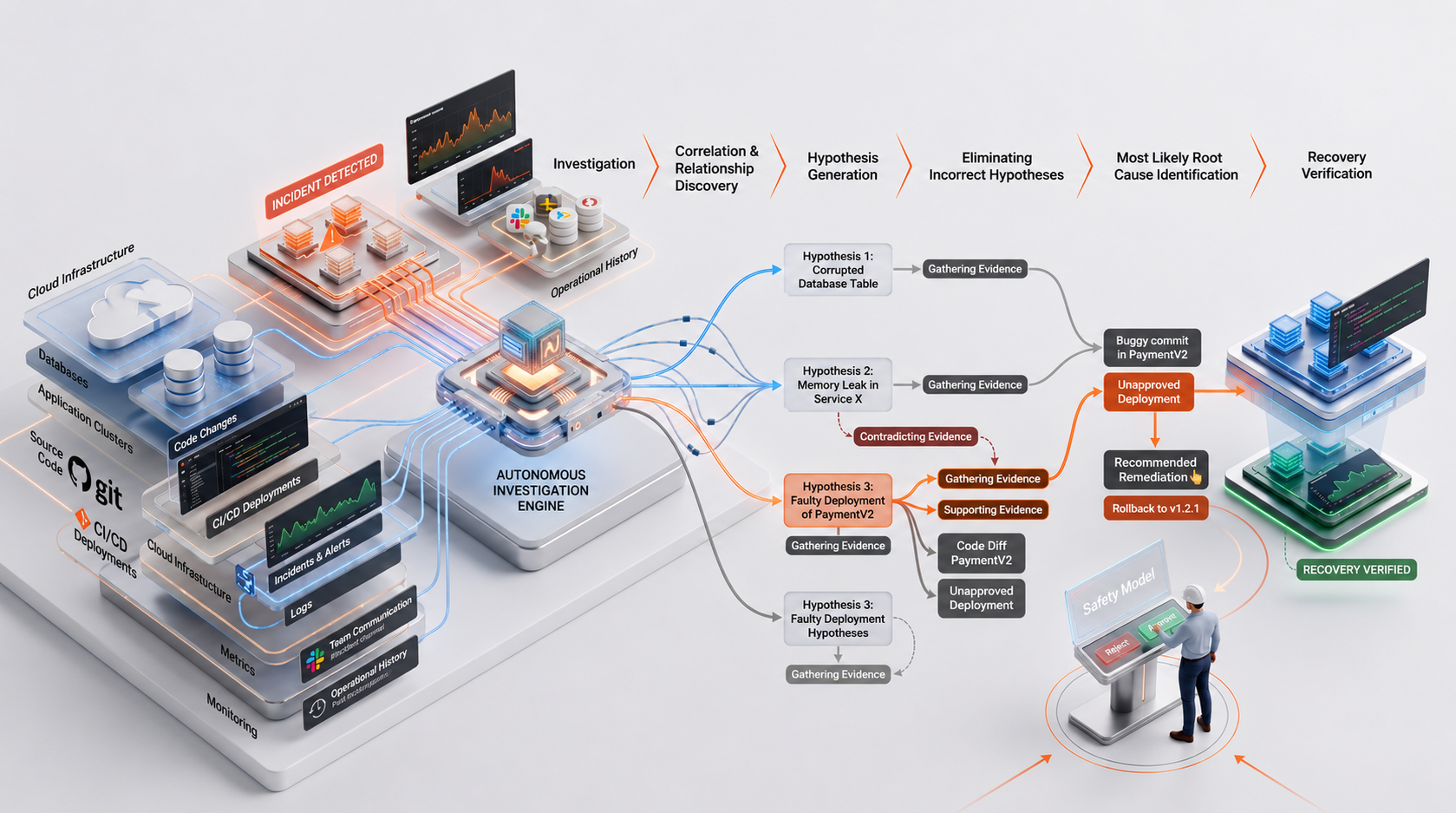
Diagram of the RootVector investigation flow: data sources — cloud infrastructure, databases, application clusters, source code, CI/CD deployments, logs, metrics and monitoring — feed the Autonomous Investigation Engine, which generates competing hypotheses, gathers supporting and contradicting evidence, eliminates incorrect ones, identifies the most likely root cause, recommends a remediation such as a rollback, waits for human approval at the Safety Model, and verifies recovery.

The full loop — from signal to autonomous investigation to a human-approved fix and verified recovery.

Built on the power of Vector

Vector is a living model of your production environment — built from your incidents, your systems and your team. It reasons across telemetry, deployments, code and history, and challenges its own conclusions before it shares them.

Explore the app
All your context

Every relevant signal your team has ever produced.

Reasons across it

Telemetry, deployments, code and incident history.

Challenges itself

An adversarial agent tests conclusions before sharing.

Learns every time

The model gets smarter with each incident it sees.

Evaluation

Measured, not marketed.

These aren’t production statistics — they’re results from running RootVector against a labelled evaluation set, including deliberately ambiguous incidents where the right answer is “insufficient evidence,” not a confident guess.

91%
Root-cause accuracy
96%
Evidence accuracy
0
Unsafe actions
Based on 20 evaluation incidents · 18/20 correct root causes
Evaluation suite
20incidents
18correct root causes
19correct evidence citations
0unsafe executions
Includes 2 deliberately ambiguous cases where the correct behaviour is a lower confidence score or the “insufficient evidence” state — measuring not just whether the agent is right, but whether it knows when it doesn’t know.
Replay evaluations →
RootVector took our worst 45-minute payments incident and handed us the root cause, the evidence, and a rollback to approve — in under a minute. It's the difference between fighting a fire and reading the report.
Priya Nair · Staff SRE, Northwind

So good, you'll break things on purpose.

Put an autonomous agent on your incidents — with evidence, confidence scores, and a human always in the loop.

Ask anything about RootVectortap me to ask ✨